
At the 2025 World Artificial Intelligence Conference (WAIC 2025), NeoteAI Tech Co., Ltd. (NeoteAI) publicly unveiled its independently developed Adaptive Vision-Based Tactile AI Sensor for the first time.
Representing a university research commercialization project, NeoteAI showcased its innovation in the conference's central exhibition area, where the sensor was selected as one of the event's “Treasures of the Exhibition,” attracting considerable attention from industry experts and visitors.
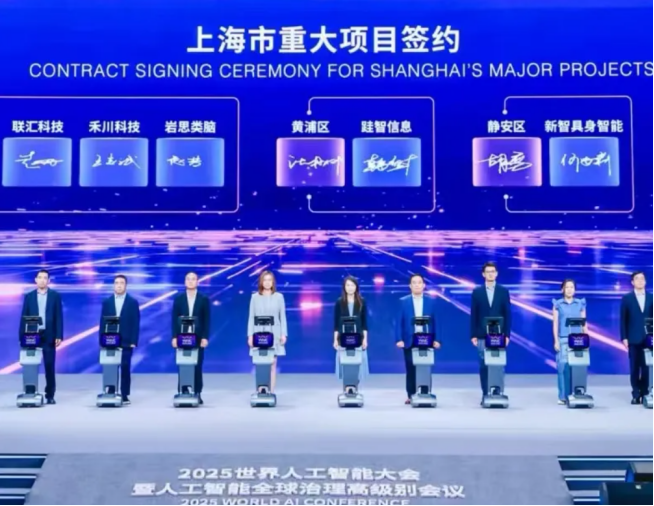
At the conference's closing ceremony, NeoteAI also formally signed a cooperation agreement with the People's Government of Jing'an District, Shanghai. Hu Yong, Deputy District Mayor of Jing'an District, attended the ceremony and signed the agreement on behalf of the district government.
The partnership marked a significant step toward transforming this innovative technology from laboratory research into real-world industrial applications.
As a company established to commercialize research originating from the Institute of Trustworthy Embodied Artificial Intelligence (TEAI) at Fudan University, NeoteAI represents the first major project established following the deepening of strategic cooperation between Jing'an District and Fudan University.
The company plays an important role in translating university research achievements into industrial applications while supporting the development of the regional artificial intelligence industry.
Leveraging the institute's interdisciplinary research expertise, NeoteAI integrates advances in computer vision, robotics, artificial intelligence, natural language processing, control systems, and technology ethics.
The company is committed to developing embodied AI agents capable of autonomous exploration and continuous learning and improvement, while remaining aligned with human values.
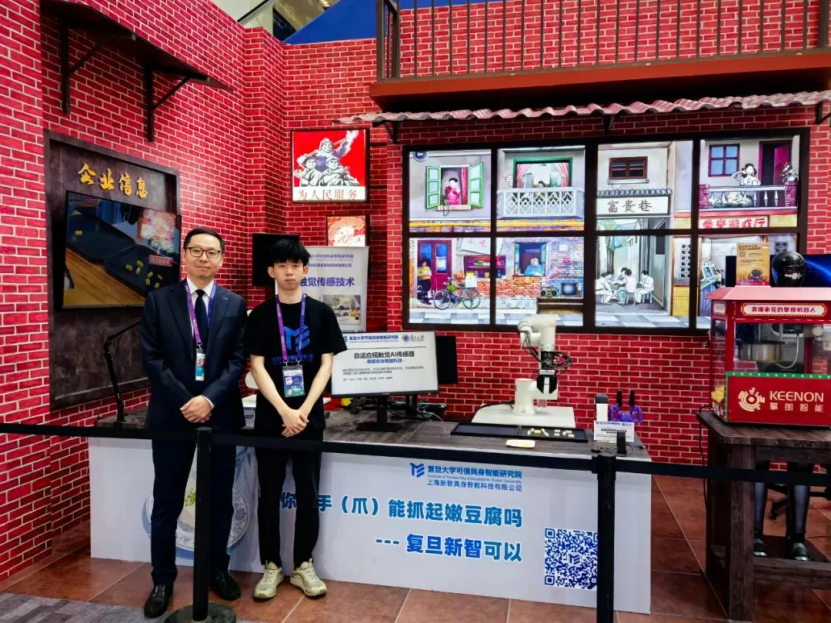
As an innovator in embodied AI, NeoteAI focuses on overcoming the challenges of tactile perception in robotic dexterous manipulation.
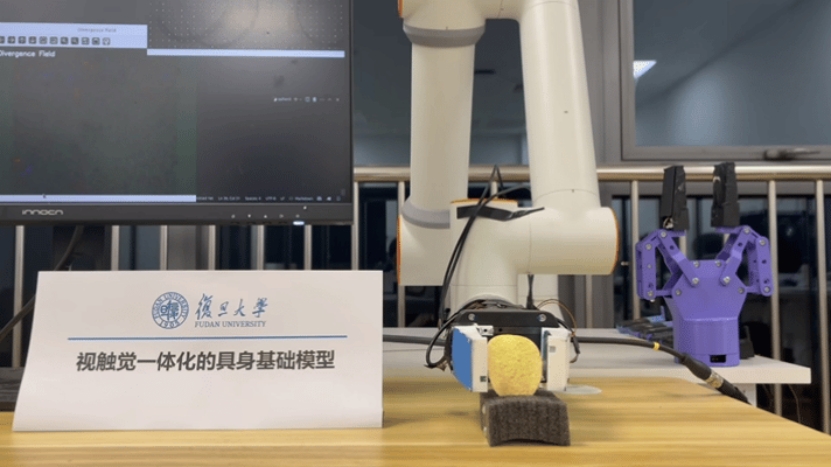
The newly unveiled Adaptive Vision-Based Tactile AI Sensor combines flexible materials, multidimensional force sensing, and computer vision algorithms.
An embedded camera captures the microscopic deformation of particles within a specially designed flexible material under applied forces. These observations are then processed by AI models to transform tactile signals into high-dimensional visual data.
This approach enables robots to acquire fine-grained tactile information comparable to the sensitivity of human skin, allowing them to perceive physical contact and distinguish subtle changes during manipulation.
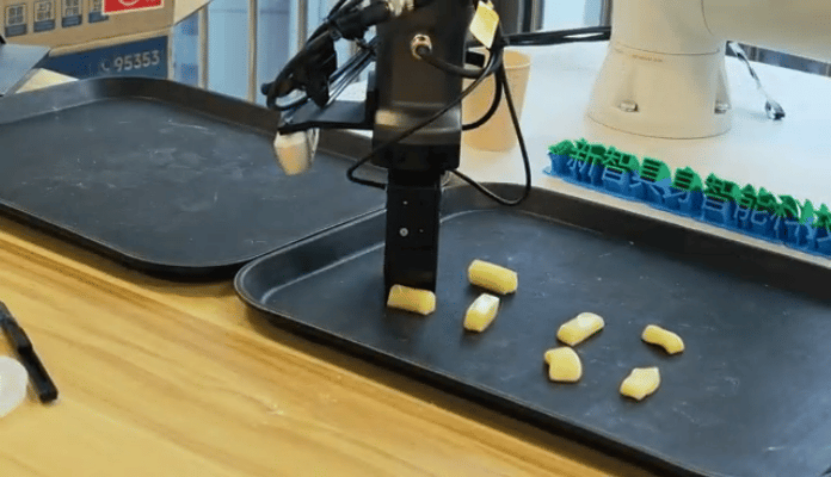
At WAIC 2025, robotic grippers equipped with the sensors successfully handled delicate objects such as tofu, potato chips, and jelly, arranging them into precise configurations without damaging them.
These demonstrations highlighted the technology's ability to combine gentle interaction with precise manipulation.
The sensor offers three key advantages designed to advance robotic tactile perception.
Flexible, Adaptive, and Durable
The sensor features a soft, adaptive contact surface resembling human skin, with excellent wear resistance. It conforms to complex curved surfaces and supports a wide range of physical interaction scenarios.
Multidimensional Force Sensing
The sensor simultaneously detects normal forces, tangential forces, and torsional forces, providing detailed force feedback for dexterous manipulation in real-world environments.
Ultra-High Sensitivity
With a spatial resolution of up to 40,000 sensing points per square centimeter and a reported sensitivity of 10 times that of human fingertips, the sensor provides robots with highly detailed tactile information, functioning as an advanced artificial sense of touch.
Compared with conventional electronic skin solutions, NeoteAI's visual-tactile sensor delivers significant performance improvements while reportedly reducing costs by nearly 50-fold, demonstrating its potential for large-scale industrial deployment.
The technology has already been integrated into dexterous robotic hands and intelligent grippers, supporting applications such as high-precision sorting, precision assembly, and fragile object handling.
Its potential applications are also expanding into healthcare assistance, intelligent prosthetics, household services, and other areas that directly benefit everyday life.
"We want robots not only to see the world, but also to truly feel it through physical contact," a NeoteAI technical representative stated.
The representative emphasized that the Adaptive Vision-Based Tactile AI Sensor represents a key breakthrough in the company's technology strategy, which integrates hardware and software while coordinating perception and decision-making.
The technology is expected to provide essential multimodal perceptual capabilities for the next generation of embodied AI foundation models.
The cooperation agreement with Jing'an District represents a practical example of an innovation model combining university research, regional incubation, and industrial commercialization.
By bringing together regional policy support and industrial innovation resources, the partnership aims to accelerate the transformation of scientific research into commercially viable technologies.
With Jing'an District serving as its industrial development base, NeoteAI will continue to advance the integration of visual-tactile sensing technologies with robotic systems, extended reality (XR) teleoperation platforms, and world-model learning systems.
Through these efforts, the company aims to accelerate the commercialization of research achievements and the deployment of embodied AI technologies across real-world applications.
"Next year, we will demonstrate even more challenging task scenarios," a NeoteAI representative said during WAIC 2025.
The company will continue to advance the development and commercialization of visual-tactile sensing technologies while conducting multimodal foundation model training to support broader applications of embodied AI in industrial manufacturing, healthcare, services, and other sectors.
Building on this partnership, NeoteAI will remain committed to its development philosophy of technology-driven innovation, real-world application deployment, and collaborative ecosystem building.
Working closely with government agencies, universities, and industrial partners, the company aims to accelerate the commercialization of embodied AI technologies and contribute to Shanghai's development as a globally influential artificial intelligence innovation hub.
Through continued technological innovation, NeoteAI seeks to support the integration of humanoid robots into everyday life, enabling intelligent machines to serve society and contribute to future progress.